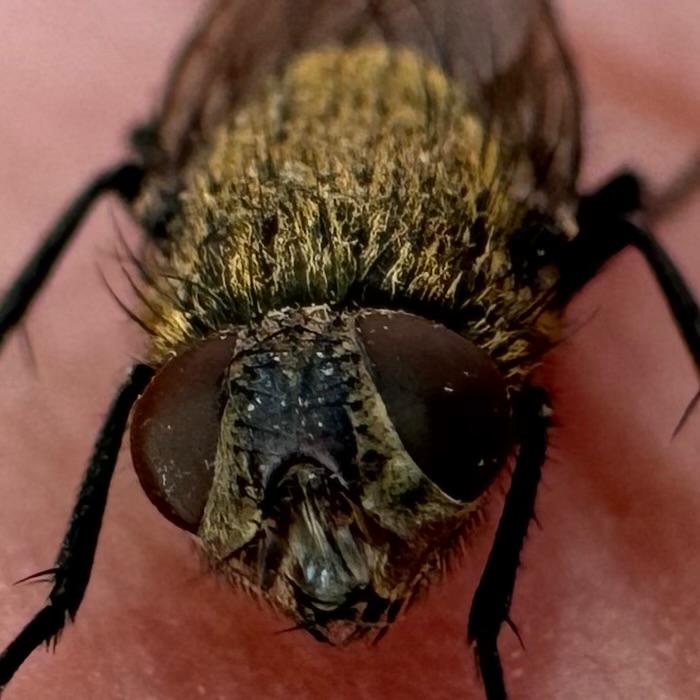
Cluster Fly
Pollenia rudis
- Classification
- Animalia › Arthropoda › Insecta › Diptera › Polleniidae › Pollenia › rudis
- Location
- Edmonton
- Habitat
- Grasslands, lawns, gardens, fields, and other areas with moist soil and vegetation. Larvae develop in soil and parasitize earthworms. Adult cluster flies often seek sheltered locations such as wall voids, attics, and other protected areas of buildings for overwintering.
- Date documented
- 2026-08-15
Identification
Medium-sized gray to dark gray fly, usually about 3/8 to 1/2 inch long. The thorax has noticeable short golden-yellow hairs, while the abdomen has darker colouring with lighter markings. The wings overlap when the fly is resting. Its overall appearance can resemble a large house fly, but the hairy thorax and darker body help distinguish it.
Biology
The cluster fly (Pollenia rudis) is a medium-sized grayish fly with golden-yellow hairs on the thorax and a dark, checkered abdomen. Adults are commonly associated with buildings because they seek sheltered spaces to overwinter. The larvae develop in soil and are associated with earthworms. One important note: GBIF currently classifies Pollenia rudis in Polleniidae, although older scientific literature commonly placed the species in Calliphoridae.
Behavior
Fyrooz's own field observation — not researched information
Cluster flies spend much of their adult life outdoors but seek protected spaces as temperatures drop. They commonly gather in attics, upper wall spaces, and other sheltered parts of buildings to overwinter. They may become active indoors during warm periods and often move toward windows or other light sources. They are generally slow-moving compared with many other common flies and do not normally reproduce inside buildings.
Macro Details
The cluster fly is a medium-sized fly, generally around 9.5–12.7 mm long. Its body is predominantly dark gray, with irregular lighter and darker markings on the abdomen. Fresh adults have noticeable golden-yellow hairs covering parts of the thorax. The wings overlap slightly when the fly is resting. The eyes are large and reddish-brown, and the antennae have a feathery-looking bristle called an arista
Fyrooz's Observation
The specimen photographed was observed at very close range, making the golden hairs on the thorax, large reddish-brown eyes, dark legs, and gray body pattern clearly visible. The fly appeared relatively robust compared with a typical small house fly. The close-up view also showed the dense hairs around the head and thorax. These visible features are consistent with a cluster fly, although confirming the exact species within the genus Pollenia can require examination of additional morphological characters.
Questions
Why do cluster flies enter houses and other buildings in large numbers? Where do cluster fly larvae find their earthworm hosts? How long does a cluster fly normally remain in the larval and pupal stages? Why are cluster flies often found around windows on warm winter days? Can cluster flies reproduce inside a house? What physical features distinguish Pollenia rudis from a common house fly? Does the presence of cluster flies indicate that earthworms are abundant nearby?
What I Learned
I learned that cluster flies have a very different life cycle from house flies. Their larvae depend on earthworms rather than household waste or decaying food. Adult flies may spend the warmer months outdoors, but they can move into buildings when colder weather arrives. They often remain hidden in wall spaces, attics, and other protected areas and may become active again when indoor temperatures rise. I also learned that the golden hairs on the thorax are a useful visual clue when examining an adult cluster fly.
Diet
Adult cluster flies mainly feed on liquids such as nectar and other plant-based fluids. The immature stage has a different feeding habit: larvae develop in soil and live as parasites of earthworms. Because of this life cycle, cluster flies are not typically associated with garbage, food waste, or decaying material as a breeding source.
Life Cycle
Cluster flies develop through four main stages: egg, larva, pupa, and adult. In North America, adults usually survive the winter in protected locations before becoming active in spring. Females place eggs in soil where earthworms are present. After hatching, the larvae enter earthworms and develop as parasites. Mature larvae leave the host, pupate in the soil, and later emerge as adult flies. The new adults feed outdoors during the warmer months before seeking sheltered overwintering sites in late summer and autumn.
Conservation Status
Not Evaluated
References
- University of Minnesota Extension — Flies
- University of Connecticut — Cluster Flies
- University of New Hampshire Extension — Cluster Flies Fact Sheet
- The Canadian Entomologist — History and current state of cluster flies in North America